
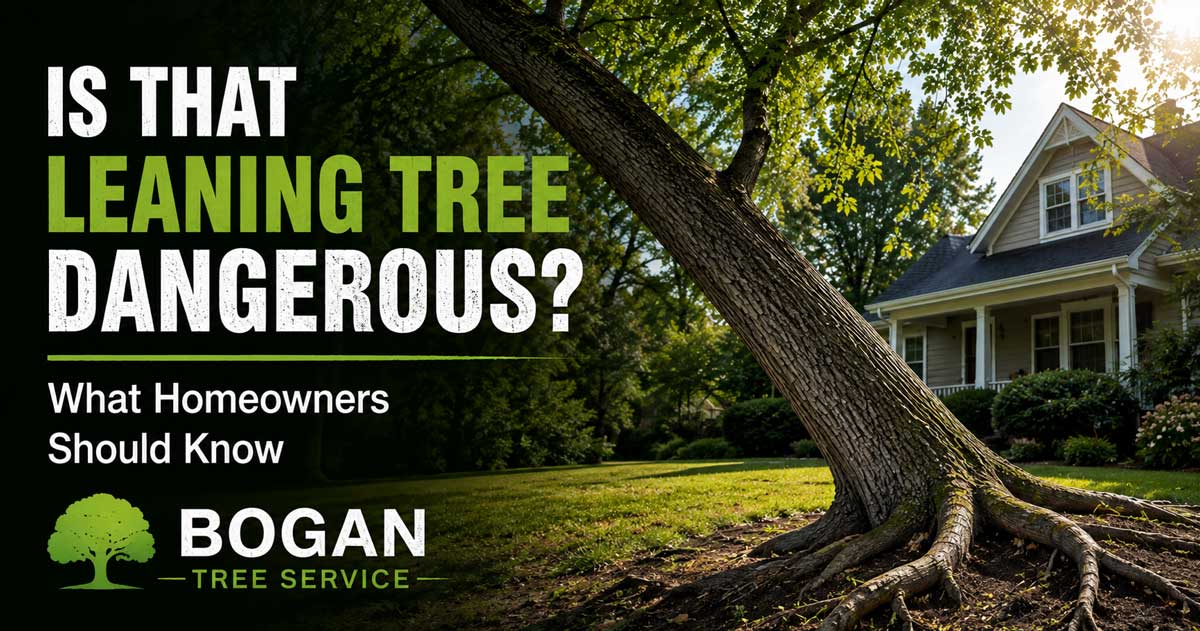
 A tree that has always grown at a slight angle isn’t necessarily a dangerous tree. But when a tree suddenly begins leaning — particularly after a strong storm, heavy rain, or high winds — it’s something homeowners shouldn’t ignore.
Penn State Extension recently addressed this issue in its article “What to Do About Leaning Trees.” The article explains that there are different types of tree lean and that understanding why a tree is leaning is important when evaluating its stability.
“Leaning trees should be inspected to determine risk to nearby people or property and any potential corrective actions.”
— Penn State Extension
A New Lean Can Be a Warning Sign
At Bogan Tree Service, one of the biggest distinctions we make is between a tree that has grown with a lean for many years and a tree whose position has recently changed.
Trees naturally adapt to their surroundings. Some grow toward available sunlight or gradually develop curved trunks while adding wood that helps support their changing structure.
A sudden lean is different.
Strong winds, saturated ground, root damage, construction activity, or soil movement can compromise the tree’s root system and cause the entire tree to shift.
Homeowners should pay particular attention to:
- Newly exposed or lifted roots
- Soil rising or cracking around the base of the tree
- A noticeable increase in the tree’s lean
- Broken or damaged roots
- Cracks in the trunk
- Large broken or hanging limbs
- A tree leaning toward a house, driveway, utility line, or other occupied area
Penn State notes that soil may actually be heaved upward on the opposite side of a leaning tree when the root plate begins lifting. That’s an important warning sign that the problem isn’t simply the angle of the trunk — the tree’s anchoring system may have been compromised.
Can a Leaning Tree Be Straightened?
Sometimes.
A recently planted or relatively small tree that has been pushed over without serious root or trunk damage may be capable of being repositioned and properly supported.
Trying to straighten a large mature tree is another matter entirely.
A mature tree can weigh many thousands of pounds. If its roots have torn or the surrounding soil has failed, attempting to pull it upright doesn’t necessarily restore its structural integrity.
That’s why the cause of the lean needs to be evaluated before deciding what should be done.
Don’t Judge a Tree by Its Angle Alone
A leaning tree isn’t automatically a tree that needs to be removed.
Likewise, a tree that appears perfectly vertical isn’t automatically safe.
Tree risk involves the condition of the trunk, roots, major limbs and surrounding soil, as well as what would be affected if part or all of the tree failed.
The Bogan Tree Service takeaway: If a tree has suddenly changed position, particularly following severe weather, don’t wait for the next storm to find out whether it’s stable. Have the tree evaluated and determine whether pruning, monitoring, stabilization or removal is appropriate.
Read the Original Article
This post was inspired by information published by Penn State Extension. Read “What to Do About Leaning Trees” for additional information:
https://extension.psu.edu/what-to-do-about-leaning-trees
Source: Penn State Extension. Original source material is quoted for educational and commentary purposes.

Call Today or Use the Contact Form below to Schedule an Appointment. We provide FREE, realistic estimates, and all work is done in accordance with ANSI guidelines.
Serving the South Shore, including: Quincy, MA | Hingham, MA | Milton, MA | Braintree, MA | Weymouth, MA | Cohasset, MA | Scituate, MA | Holbrook, MA | Hull, MA
Just click on the Phone Number to dial on your phone:
617-479-2444